Your Cart is Empty


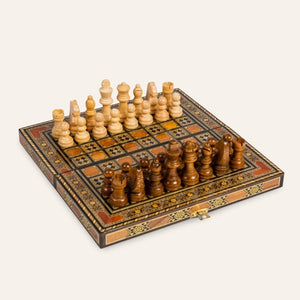
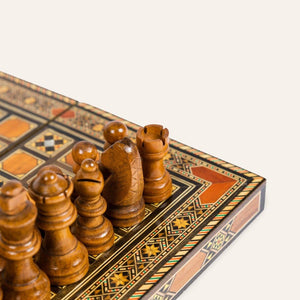
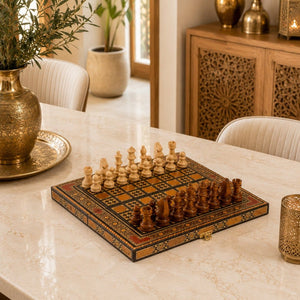
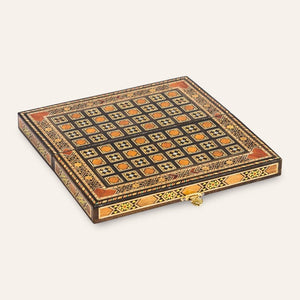
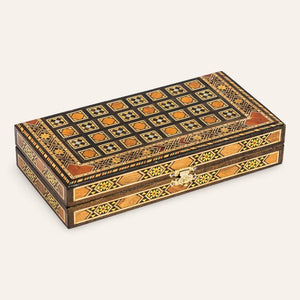
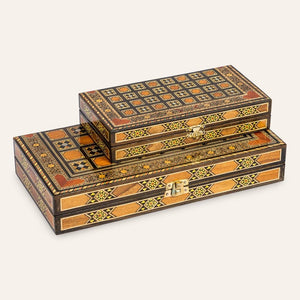


This chess set is handcrafted in Damascus, the traditional home of marquetry and the birthplace of this artisanal craft. The quintessential strategy game is adorned with marquetry to bring a unique decorative style to your rooms.
* Made of wood and marquetry.
* Available in 2 sizes.
* Made in Damascus.
DIMENSIONS
Medium: 30cm long, 15cm wide, 5cm thick. Board 30x30cm
Big: 40cm long, 20cm wide, 7cm thick. Board 40x40cm
* The board YEAH It includes the chess pieces.
-
ABOUT MARBLE OF DAMASCUS
Marquetry is a craft technique applied to the covering of floors, walls, furniture, sculptures, and artistic objects. The work involves using pieces cut from different materials (stone, marble, wood, metals, etc.), which are fitted together onto a surface to create the decorative design. It is an inlay technique. The contrast between the pieces depends on the color and characteristics of the material used.
In marquetry, the base layer between each inlaid piece is not visible, as it is in mosaic. The material to be inlaid is cut into the shape of the design, placed on the surface or support, and the outline is drawn. Once the design is transferred to the support, it is slightly hollowed out, leaving a space where the marquetry will be inlaid; then the entire surface is smoothed and leveled.
There are records of marquetry work dating back to the Sumerian period in Mesopotamia (3000 BC) and the Ming Dynasty (1368-1644) in China. It spread throughout Asia Minor (modern-day Turkey) and was later adopted by the Romans upon their contact with the Hellenistic world. They called this art incrustatio or loricatito. Pliny the Elder provides an extensive description of this technique in his work Natural History. He refers to the pieces used for inlays as crustae. The Arabs introduced this technique to Spain; hence, taracea derives from the Arabic word Tar'sia, meaning inlay.


