Your Cart is Empty



The Moroccan pottery making It is a centuries-old tradition, where everyday items are handcrafted using a method passed down from generation to generation. All the Moroccan handicrafts They are made with materials obtained from the immediate environment.
From Alcazaba Decoration as Suppliers of Arab handcrafted products we want to bring you closer to Moroccan ceramic production process so that you can learn even more about the culture and its traditions.
In order to to make Arabic ceramics Our raw material is clay, which is crushed by hand so it can be soaked for several days in a container of water to soften it. Once soaked, it is spread on the ground to dry for two days.
Following this process, the clay for making Moroccan pottery The clay is kneaded first with the feet and then by hand to prevent lumps from forming. Once the clay is coarse, it is further kneaded by hand and then shaped on a traditional potter's wheel. The hands will work to mold the piece and transform it into the desired object.

Once the piece has been manufactured, it must be hardened in a kiln for 48 hours. This step is essential to obtain a resistant ceramic piece without risk of breakage or cracking. cooling of Arab ceramics It lasts about 24 hours and you get a piece called a biscuit, although it is not completely finished.
Finally, the pieces are coated with a white enamel called tinplate so that they can decorate Moroccan pottery with a brush and Design it with geometric motifs, inspired by the Alhambra, verses from the Quran, cultural symbols, the artisan's personal stories, etc. most characteristic of Arab ceramic pieces They stand out for their wide range of colors and decorations.
After decoration, the piece must be glazed and fired a second time for 48 hours to obtain the finished product, ready for use. Following this process, tin ornaments, a characteristic detail of the pottery, can be added.
The colors that make up the Moroccan ceramics They are blue, green, brown, and yellow, where each color corresponds to a region of the country.

The tradition of making Moroccan handicrafts by hand It dates back to the 12th century, specifically to Fez and Safi, since the region has high-quality clay. During the 19th century, there was a massive influx of potters who founded the Morocco's first traditional porcelain and ceramic workshops. They were manufactured unique pieces with typical decoration and the potters combined it in shades of blue and white.
The ceramic artisans of Fez They use the double baking technique, as we have mentioned before, which is essential to give the pieces a bright and characteristic color.
This city is also the source of the green roof tiles that can be found during a visit to this Moroccan city; they are used for buildings and mosques. Although there are other cities that possess a strong tradition in the production of Moroccan ceramics such as Sidi Abderrahmane and the Chaaba Valley.

So great is the pottery tradition in the city of Fez that we can visit a museum dedicated to ceramics.It is located in the former governor's palace and is an old fortress built by the Portuguese in the 16th century.
During your visit to the palace, you can see local potters displaying some of their oldest pieces, showcasing the evolution of the city's rural pottery and ceramics. You can also explore the surrounding streets to discover more. How is typical Fez pottery made? during each of its phases.
The Moroccan pottery making It is a centuries-old tradition, where everyday items are handcrafted using a method passed down from generation to generation. All the Moroccan handicrafts They are made with materials obtained from the immediate environment.
From Alcazaba Decoration as Suppliers of Arab handcrafted products we want to bring you closer to Moroccan ceramic production process so that you can learn even more about the culture and its traditions.
In order to to make Arabic ceramics Our raw material is clay, which is crushed by hand so it can be soaked for several days in a container of water to soften it. Once soaked, it is spread on the ground to dry for two days.
Following this process, the clay for making Moroccan pottery The clay is kneaded first with the feet and then by hand to prevent lumps from forming. Once the clay is coarse, it is further kneaded by hand and then shaped on a traditional potter's wheel. The hands will work to mold the piece and transform it into the desired object.
Once the piece has been manufactured, it must be hardened in a kiln for 48 hours. This step is essential to obtain a resistant ceramic piece without risk of breakage or cracking. cooling of Arab ceramics It lasts about 24 hours and you get a piece called a biscuit, although it is not completely finished.
Finally, the pieces are coated with a white enamel called tinplate so that they can decorate Moroccan pottery with a brush and Design it with geometric motifs, inspired by the Alhambra, verses from the Quran, cultural symbols, the artisan's personal stories, etc. most characteristic of Arab ceramic pieces They stand out for their wide range of colors and decorations.
After decoration, the piece must be glazed and fired a second time for 48 hours to obtain the finished product, ready for use. Following this process, tin ornaments, a characteristic detail of the pottery, can be added.
The colors that make up the Moroccan ceramics They are blue, green, brown, and yellow, where each color corresponds to a region of the country.
The tradition of making Moroccan handicrafts by hand It dates back to the 12th century, specifically to Fez and Safi, since the region has high-quality clay. During the 19th century, there was a massive influx of potters who founded the Morocco's first traditional porcelain and ceramic workshops. They were manufactured unique pieces with typical decoration and the potters combined it in shades of blue and white.
The ceramic artisans of Fez They use the double baking technique, as we have mentioned before, which is essential to give the pieces a bright and characteristic color.
This city is also the source of the green roof tiles that can be found during a visit to this Moroccan city; they are used for buildings and mosques. Although there are other cities that possess a strong tradition in the production of Moroccan ceramics such as Sidi Abderrahmane and the Chaaba Valley.
So great is the pottery tradition in the city of Fez We can visit a museum dedicated to ceramics. It's located in the former governor's palace, an old fortress built by the Portuguese in the 16th century.
During your visit to the palace, you can see local potters displaying some of their oldest pieces, showcasing the evolution of the city's rural pottery and ceramics. You can also explore the surrounding streets to discover more. How is typical Fez pottery made? during each of its phases.
Fez is one of Morocco's most emblematic cities in terms of Moroccan ceramics. The artisans of this city are known for their skill in working with clay, creating unique pieces that not only represent Moroccan tradition, but also mastery in the manufacturing of handcrafted ceramics. The Fez pottery It is especially famous for its vibrant colors, intricate geometric patterns, and glossy enamel finish that captures the essence of Moroccan art.
The most representative pieces of Fez pottery include plates, tagines, and teapots, used both in daily life and for special celebrations. The double-firing technique, characteristic of this city, makes the pieces more durable and gives them a distinctive luster. This pottery is a symbol of Fez's rich cultural heritage, where each piece tells a story through its decorative details.
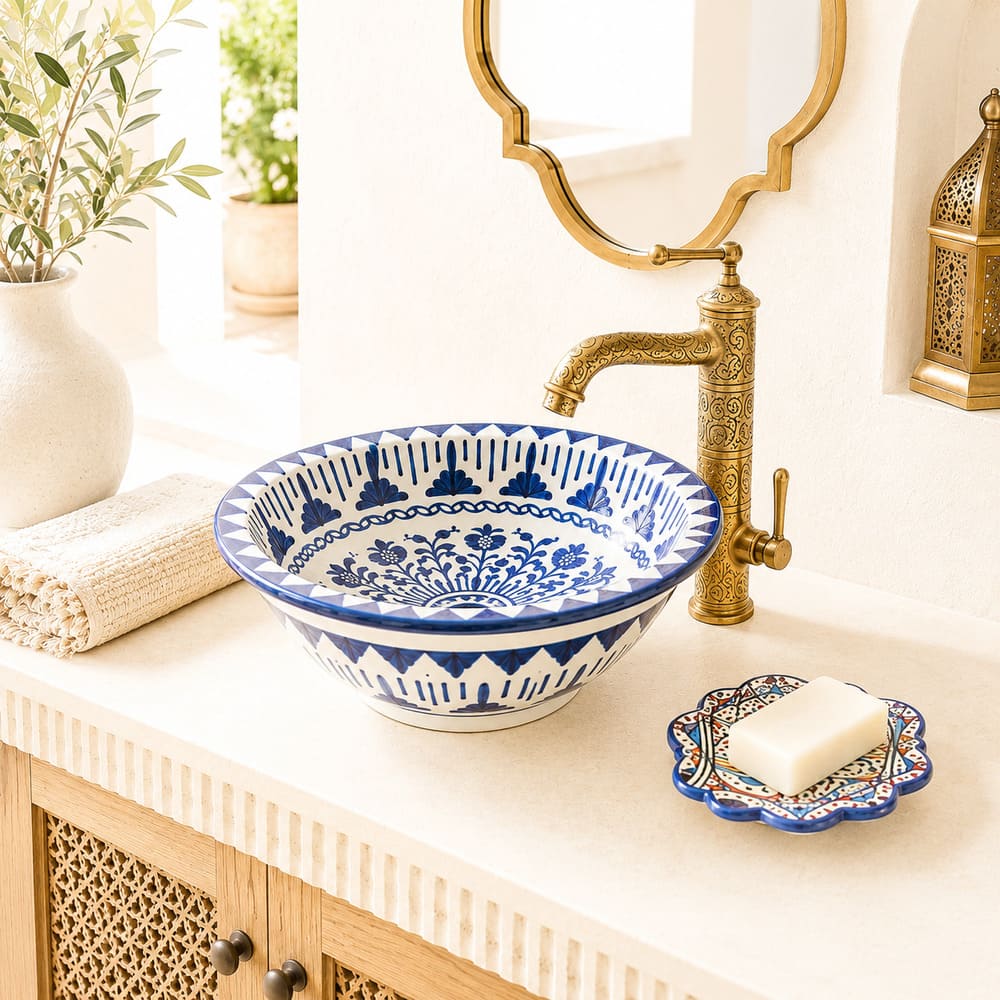
The Arabic ceramics It has had a tremendous influence on modern decor, especially in the creation of spaces that blend the traditional with the contemporary. Many interior designers draw inspiration from its intricate geometric patterns and vibrant colors. Moroccan ceramics To create inviting and sophisticated environments, Arabic ceramic tiles are commonly used in bathrooms, kitchens, and accent walls to add a touch of exoticism and cultural richness to spaces.
Nowadays, it is common to see pieces of Moroccan ceramics In interior design worldwide, both in private homes and commercial spaces, the incorporation of these elements of Arab culture adds a sense of luxury and sophistication, while preserving a connection to Morocco's artisanal traditions.
The Moroccan ceramics It is more than just a form of decoration; it is an art that has been passed down from generation to generation. Ceramic production is a fundamental activity for rural Moroccan communities, where artisans teach traditional manufacturing techniques to younger generations. This ensures that Moroccan ceramics remain an integral part of the country's culture.
Each region of Morocco has its own specialty in the Moroccan ceramics, which gives it a rich diversity and a wide range of styles, colors, and techniques.From the intricate ceramic mosaics of Fez to the hand-decorated tagines of Marrakech, Moroccan ceramics offer a vast collection of unique pieces that tell stories about the country's life, religion, and traditions.
The Arabic ceramics It's not limited to interior design. In recent years, it has also begun to influence the world of fashion. Accessories and details inspired by Moroccan ceramics, such as necklaces, bracelets, and earrings, have become popular in the fashion industry. These handcrafted accessories capture the essence of Arabic pottery and transform it into unique pieces of jewelry that stand out for their artisanal beauty.
The geometric patterns and vibrant colors characteristic of Moroccan ceramics are used in a variety of designs, creating accessories that are both artistic and modern. This trend allows people to carry a piece of Morocco's rich culture with them in a stylish and sophisticated way.
Moroccan ceramics, especially the Moroccan ceramics, Moroccan ceramics have left an indelible mark on interior design worldwide. They are used in a variety of ways to cover walls, floors, and tables, creating spaces full of character and tradition. Furthermore, Moroccan ceramics are not limited to large pieces like tiles; they also appear in small decorative details such as vases, cups, and plates.
Incorporating Moroccan ceramics into your home decor can transform any space, infusing it with warmth, color, and a deep cultural connection. Whether through a set of plates or a handcrafted ceramic table, each piece contributes to creating a unique and inviting atmosphere, steeped in history and tradition.
The handcrafted ceramic production In Morocco, it also reflects a sustainable and ecological approach to art production. Moroccan artisans use natural materials and traditional techniques that minimize environmental impact. Moroccan ceramics are handmade, meaning no industrial machines or harmful chemicals are used to create the pieces.
Furthermore, the ceramic production process in Morocco follows circular economy principles. Clay waste is reused in the manufacture of new pieces, and artisans employ local resources, resulting not only in unique products but also in environmentally friendly practices. This method of producing handcrafted ceramics represents a sustainable model that other industries could adopt to protect our planet.
 Envios gratis
Disfruta de tu compra el